
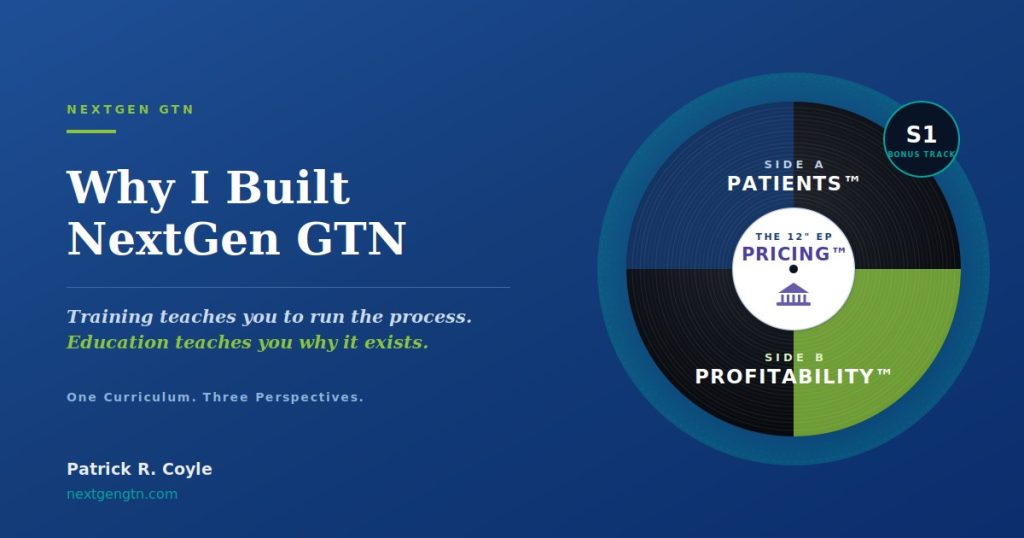
The short version: Training teaches you to run the process. Education teaches you why the process exists. NextGen GTN™ exists because Finance, Market Access, Trade and Patient Services can each be right inside their own function while the number still misses, and no one has taught them the same event from both sides. The curriculum is built like a record: Side A follows the patient journey through commercial eyes, Side B covers the same events through the financial layers.
NextGen GTN™
Training teaches you to run the process. Education teaches you why the process exists.
By Patrick R. Coyle
I have spent close to two decades in rooms where everyone was right and nobody agreed.
Finance is right that the accrual moved and no one warned them. Market Access is right that the contract they signed was the best available. Trade is right that the channel performed exactly as designed. Patient Services is right that the program works for the patients who reach it. Government Pricing is right that the calculation is correct as specified.
Every one of those can be true in the same quarter, in the same company, about the same product. And the number still misses.
That is not a competence problem. I have worked with extraordinary people in all of those seats. It is a perspective problem. Each function is looking at a different slice of one continuous event, and nobody is holding the whole thing.
What Training Does, and What It Does Not Do
There is no shortage of gross-to-net training available, and most of it is good at what it sets out to do. It teaches you to run a calculation, operate a system, close a process, satisfy a requirement.
Training answers how. How to compute the unit rebate amount. How to validate a chargeback. How to close the accrual.
What it rarely answers is why. Why does this deduction exist at all? What was it originally solving for? Who argued for it, who resisted it, and what did each side fear? What did the last three policy cycles do to it? And most of all, what does this same transaction look like from the seat across the table?
A team that knows how but not why can execute a process flawlessly and still be surprised by its own results.
That is the gap I built NextGen GTN™ to close. Not more instruction on the mechanics. Shared understanding across functions that have to live with each other’s decisions.
So I Built It as a Record
A record has two sides. Same album, same session, same artist. You can play either side on its own and it makes sense. But the sides were sequenced together, and the person who made them intended you to hear both.
The Two Sides of the Vinyl™ is built that way. Eighteen sessions in total: six tracks on each side, a five-track lens that belongs to both, and one standalone. Every session is thirty slides and runs about two hours.
Side A · Patients™ · commercial teams
Six tracks. Twelve hours.
Follows the 10 Exits of Therapy™. The journey as the patient actually experiences it, and what it costs when someone leaves.
A1 Patient Journey Foundations™
Where the road begins
A2 Channels & Commercialization Architecture™
Same medicine, different address
A3 Coverage & Authorization™
The wait with no clock
A4 The Prescription Transaction™
From intent to therapy
A5 Affordability & Utilization™
Covered is not the same as affordable
A6 The Last Mile and What Follows™
Approval is not arrival
Side B · Profitability™ · finance teams
Six tracks. Twelve hours.
Follows the Five Layers of GTN™. The same journey as the enterprise records it. Clinical and Product. Access and Policy. Channel and Distribution. Affordability and Patient Support. Financial Visibility and Enterprise Performance.
B1 Defensible Forecasting™
Before a prescription exists
B2 Where Possibility Meets Permission™
Market access is a financial topic, not a medical one
B3 Building the Road on Purpose™
Distribution is no longer logistics
B4 What the Card Doesn’t Say™
Copay spend is growing. Volume is not.
B5 The Two Ledgers™
Where the number actually comes from
B6 The Leakage Ledger™
Fill data describes the patients you kept
The Sides Pair by Topic, Not by Number
This is the part people expect to be simpler than it is. A1 does not pair with B1 because they share a digit. They pair because they are describing the same event.
Every session names its counterpart on a cross-thread slide. A3, the coverage and authorization funnel, pairs with B2, where that funnel gets priced. A5, affordability, pairs with B4, what the copay card does not say. A2, the channel architecture, pairs with B3, where the road gets built on purpose.
Side A counts. Side B prices the same figures.
A patient who abandons at the pharmacy counter is an affordability exit on Side A and a Layer 4 event with a Layer 5 consequence on Side B. Same moment. Two grooves.
The Standalone Track
S1 · both audiences · one track, two hours
The Many Faces of 340B™
Transparency, tension, and the future of pharmaceutical access
340B does not sit cleanly on either side, which is exactly why it stands alone. The session teaches the statute, the ceiling price calculation, how the discount is actually delivered through a wholesaler chargeback, who validates entity eligibility and what never gets validated. Then it argues all four positions on the program as their holders would argue them, and refuses to issue a verdict.
The Lens: Government Pricing
Five more sessions sit across both sides rather than on either one. Government Pricing Through the Commercialization Lens™ follows neither the exits nor the layers. It follows the transaction, from the room where it is designed to the number that eventually gets reported.
It exists on one premise. Government pricing is not an isolated compliance function. It is one of the financial expressions of decisions made across commercialization. Every government price begins with a commercial decision.
Five tracks. Ten hours. Both audiences in the same room.
G1 The Government Pricing Ecosystem™
From commercial transaction to government price
G2 The Transaction Matters™
What exactly are we paying them to do?
G3 The Ripple Effect™
One commercial decision. Multiple financial consequences.
G4 Government Pricing at Launch™
Build it before the first transaction
G5 Modeling the Money™
Three views of the same dollar
The sequence is deliberate. Each session moves the same question one step earlier than the last, until you are standing in the room where the decision was originally made.
Two Delivery Modes, One Set of Slides
Every session is thirty slides and runs about 120 minutes either way. The six polling questions sit at the same positions in both modes, and the applied exercise is unchanged.
Narrated, self-guided
Recorded narration on every slide, roughly two minutes each, advancing automatically. A slide unlocks after one minute so anyone who wants to move faster can. Carries progress tracking, engagement checks, the final assessment and the certificate.
Instructor-led
Delivered live, in the room or virtually, from the same slides and the same speaker notes. Three minutes a slide is the target. Carries live polling, the applied exercise and Q&A.
On continuing professional education: accreditation is pending. Anticipated credit is 2.0 per session and 36.0 across the full curriculum, subject to accreditation. Individual session materials do not state a credit value until that is confirmed, and I would rather say so plainly than imply otherwise.
What You Should Walk Out With
Why each deduction exists
Not just how to calculate it. What problem it was created to solve, and whether it still solves it.
How we got here
The policy history underneath the mechanics, because almost every strange rule is a fossil of an old argument.
What the other seat sees
The same transaction described in the vocabulary of the function you argue with most.
A shared language to disagree in
The goal is not consensus. It is disagreement that is actually about the thing, rather than about definitions.
How to Listen to It
Start with the side you do not live on.
If you close the books, start on Side A. If you negotiate access or run patient services, start on Side B. You already know your own side. What you are missing is the vocabulary of the person you keep failing to convince.
Then play the other one. That is when the sequencing does its work.
This site is where the liner notes live. Articles that go deeper on individual tracks, policy as it moves, and the working reasoning behind the frameworks. Everything here is free and always will be. The sessions are where the material is taught properly, with the artifacts, the applied exercises and the assessment.
Two sides. One record. The same patient on both.
About the Author
Patrick R. Coyle built the NextGen GTN™ curriculum and the Patients + Profitability™ philosophy it rests on. He previously served as VP & CFO of Eisai Americas and led Gross-to-Net practice areas at two global advisory firms, with senior finance and commercial roles at Novartis, Insmed, and Bayer.
More frameworks, guides, and tools in the Resource Library. Reach him at hello@patrickrcoyle.com.