
The short version: Gross-to-Net variance is not a finance problem. Finance is held accountable for a number produced by decisions it did not make: how the population was sized, how the contract was written, how the network was negotiated and how affordability was designed. The fix is for Finance to move upstream and ask, before each decision is final, which metrics are observed rather than inferred, whether Finance is in the room, and whether the variance can be attributed to a decision with an owner.
Layer 05 · Financial & Reporting
Finance is held accountable for a number produced by four decisions it did not make.
By Patrick R. Coyle
Ask what Layer 5 decides and the honest answer is almost nothing. It reports.
The population was sized in Layer 1. The contract and the utilization management attached to it were agreed in Layer 2. The network and the data rights were set in Layer 3. The affordability instruments were designed in Layer 4.
Then the number arrives, and the people who receive it are asked to explain it.
The aggregate is now enormous
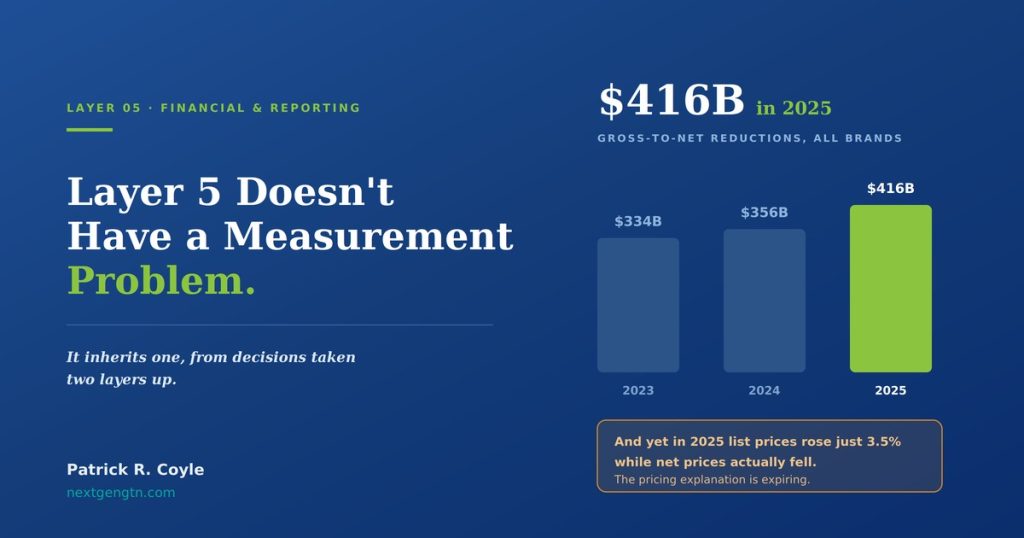
Drug Channels Institute estimates that total gross-to-net reductions across all brand-name drugs reached $416 billion in 2025, up from $356 billion in 2024 and $334 billion in 2023.
Gross-to-net reductions, all brand-name drugs
2023 $334B
2024 $356B
2025 $416B
For the manufacturers that disclose enough to check, rebates, discounts and fees have reduced brand selling prices to less than half of list.
The explanation everyone has been using is expiring
For two decades the story had a simple shape. List prices rose, rebates rose faster, and the gap between them widened. Gross-to-net erosion was a pricing phenomenon, and it was somebody else’s fault.
That story no longer describes the data.
In 2025, average brand list prices grew by just 3.5 percent, and average net prices actually fell, both before and after inflation. Through the first three quarters, nominal net prices declined by 0.7 percent. Manufacturers cut list prices on more than 20 brand products across 2024 and 2025, and further cuts are expected to reduce gross brand revenues by tens of billions.
If net price is falling and net revenue still misses, the miss is not a pricing problem. It never entirely was.
This matters more than it first appears. Rebate-driven list inflation was the explanation of last resort for a generation of forecast variance. As it deflates, that explanation goes with it, and what is left underneath is volume, mix and the patient journey. Which is to say, Layers 1 through 4.
Inheritance, not failure
Layer 5 is usually described as having a data problem. Better dashboards, better reconciliation, better accrual methodology, a better system.
It does not have a data problem. It has a data inheritance.
Every field Layer 5 can observe is a contract clause somebody negotiated in Layer 3 and an operational obligation somebody accepted in Layer 4. Neither can be added retroactively. A brand that traded away dispense-level visibility during network negotiation has decided, without a meeting on the subject, that its gross-to-net variance will be explained in aggregate and after the fact, permanently.
No reporting investment fixes that. You cannot reconcile your way to a field that nobody is contractually obliged to supply.
Explanation is not attribution
Most gross-to-net reporting explains. It describes what the number did, decomposed by deduction category, against forecast and against prior period.
Attribution is a different exercise. It asks which decision, taken by whom and when, produced the movement.
The difference shows up in the meeting. Explanation produces “commercial rebates were 180 basis points unfavorable.” Attribution produces “180 basis points, of which roughly two thirds is the mix shift that followed the network decision taken in March, and one third is the accumulator exposure in the plans we added in the second quarter.”
The first sentence ends the conversation. The second one starts a different one, in which somebody other than Finance has something to answer.
Three questions that move Layer 5 upstream
Which of our current metrics are observed, and which are inferred?
Observed means a named party supplies the field under a contractual obligation you can point to. Everything else is inferred from an assumption that has an owner, or should. Rooms consistently overstate the observed column.
Is Finance in the room when the network and the contract are decided?
Not to approve the deal. To ask what will need to be visible afterwards, while there is still a negotiation in which to ask for it.
When the number moves, can we name the decision?
If the best available answer is a deduction category, you are explaining. If it is a decision with a date and an owner, you are attributing.
Layer 5 will never be where the problem is created. That is not a weakness of the function, it is a property of the sequence. But it is the only layer that sees the whole consequence, which makes it the natural place to ask the upstream question, provided it asks before the decision rather than after the close.
Layer 5 does not have a measurement problem. It inherits one, from decisions taken two layers up by people who were never asked what would need to be visible later.
Sources. Gross-to-net reduction totals for 2023, 2024 and 2025, list and net price movement for 2025, and manufacturer list price reductions are from Drug Channels Institute analyses published in 2025 and 2026. Estimates vary between analysts depending on whether drugs that have lost exclusivity are included; figures here are on a consistent all-brand basis as published. The 180 basis point example is illustrative and does not describe any product, manufacturer or engagement. No client data is used.
About the Author
Patrick R. Coyle built the NextGen GTN™ curriculum and the Patients + Profitability™ philosophy it rests on. He previously served as VP & CFO of Eisai Americas and led Gross-to-Net practice areas at two global advisory firms, with senior finance and commercial roles at Novartis, Insmed, and Bayer.
More frameworks, guides, and tools in the Resource Library. Reach him at hello@patrickrcoyle.com.