
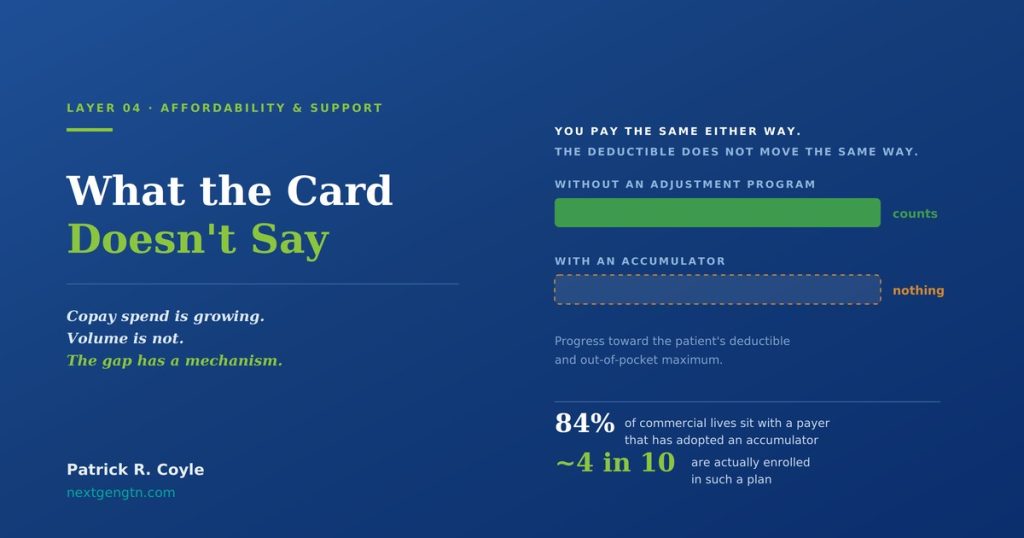
The short version: Copay spend is growing and volume is not because accumulator programs strip the assistance out of the deductible. The patient hits the full deductible after the card runs dry while the manufacturer’s spend stays the same. Track four things on one page: cost per persistent patient rather than per enrollment, actual accumulator exposure by segment, the month assistance typically depletes, and who owns the patient’s transition when it does.
Layer 04 · Affordability & Support
Copay spend is growing. Volume is not. The gap has a mechanism.
By Patrick R. Coyle
A copay program is presented internally as a benefit. It is described in patient terms, budgeted in program terms, and reported in enrollment terms.
It is a deduction with an eligibility test attached. Everyone in the room can name the benefit. Very few can name the deduction, and almost nobody can name what happens to the money after it leaves.
What an adjustment program actually does
Historically, manufacturer assistance counted toward a patient’s deductible and out-of-pocket maximum. The patient reached their cap faster, and the plan picked up costs sooner.
Under a copay accumulator, that stops. The assistance still reduces what the patient pays at the counter, but it no longer counts toward the deductible or the out-of-pocket maximum. Under a maximizer, the assistance is captured differently but with the same outcome for the patient’s cost-sharing progress.
The same dollar, two designs
Without an adjustment program. You pay. The patient’s deductible progress moves. They reach the cap, the plan takes over, and the patient stays on therapy.
With one. You pay the same amount. The patient’s deductible progress does not move. When your assistance is exhausted, they meet the full deductible for the first time, months in, with no warning.
The spend is identical. What it purchased is not.
How common is this, honestly
Two numbers get quoted interchangeably and they measure different things. The distinction is worth holding onto.
Payer adoption. As of September 2025, payers representing 84 percent of commercial lives had implemented at least one copay accumulator program, and payers representing 81 percent had an active maximizer program.
Member exposure. As of late 2025, roughly four in ten commercially insured lives were actually enrolled in a plan using an accumulator or a maximizer.
Adoption tells you the capability exists across most of the market. Exposure tells you how many patients are sitting inside it. Planning against the first number overstates your problem. Planning against neither, which is more common, means you do not know your exposure at all.
Concentration matters more than the average. IQVIA data indicates deductible accumulator prevalence among oncology brands quadrupled between 2019 and 2024, from 6 percent to 24 percent of commercial patients. Your category is not the market.
Third-party adjustment behavior changes the deduction without changing the benefit. That is precisely why the two have to be tracked separately.
The regulatory picture will not rescue you
State legislation continues to advance. New Jersey became the 26th state to enact an anti-accumulator law in January 2026.
The practical reach is narrower than the headline. These laws generally apply to state-regulated plans, meaning fully insured and marketplace coverage. Self-funded employer plans, which account for the majority of commercial coverage, sit outside that authority. One estimate put the share of the total US commercial market required to count assistance toward cost-sharing limits at around 17 percent for 2025.
And where accumulators are restricted, maximizers frequently are not, which makes substitution the likely response rather than retreat.
Why this is an ownership problem before it is a design problem
Copay design sits with Patient Services, which is measured on patients reaching therapy. Market Access is measured on coverage. Finance is measured on net price.
All three are optimizing correctly. All three are funded. And two of them are spending out of the same deduction line that the third is accountable for defending.
The characteristic failure is not a bad program. It is a well-run program whose second-order cost is discovered at the first true-up, by a function that was not in the room when it was designed.
Four things to put on one page
Cost per persistent patient, not cost per enrolled patient
Enrollment counts people who filled a form. Persistence counts people still on therapy. If your program reports the first and not the second, it is reporting activity.
Your actual adjustment exposure, by segment
Not the market average. Your patients, your plan mix, your category. If nobody can produce it, that is the finding.
The month your assistance typically exhausts
That is the month a share of your patients meet a cost they were never told about. Somebody should know the date before the patient does.
Who owns the transition between instruments
A patient moving from bridge to copay assistance to patient assistance crosses two boundaries. Name who watches that, by name, not by function.
None of this argues against copay assistance. Patients need it, and where it works it is the difference between a prescription and a therapy. The argument is narrower: if you cannot state what a dollar of assistance buys in your own book, you are not running a program. You are running a subsidy with a reporting layer attached.
An instrument is not a benefit. It is a deduction with an eligibility test attached, and somebody else may be deciding what it is worth.
Sources. Payer adoption figures are from MMIT research reported as of September 2025. Member enrollment share, the estimated proportion of the commercial market subject to count-assistance requirements, and the New Jersey legislative milestone are from Drug Channels Institute analysis published in 2026. Oncology accumulator prevalence is from IQVIA data covering 2019 to 2024. State law counts vary by source and by how partial statutes are treated. No product, manufacturer, payer or commercial arrangement is described or implied, and no client data is used. Nothing here is legal advice; copay instrument eligibility by patient state carries federal anti-kickback and beneficiary inducement considerations that belong with counsel.
About the Author
Patrick R. Coyle built the NextGen GTN™ curriculum and the Patients + Profitability™ philosophy it rests on. He previously served as VP & CFO of Eisai Americas and led Gross-to-Net practice areas at two global advisory firms, with senior finance and commercial roles at Novartis, Insmed, and Bayer.
More frameworks, guides, and tools in the Resource Library. Reach him at hello@patrickrcoyle.com.