
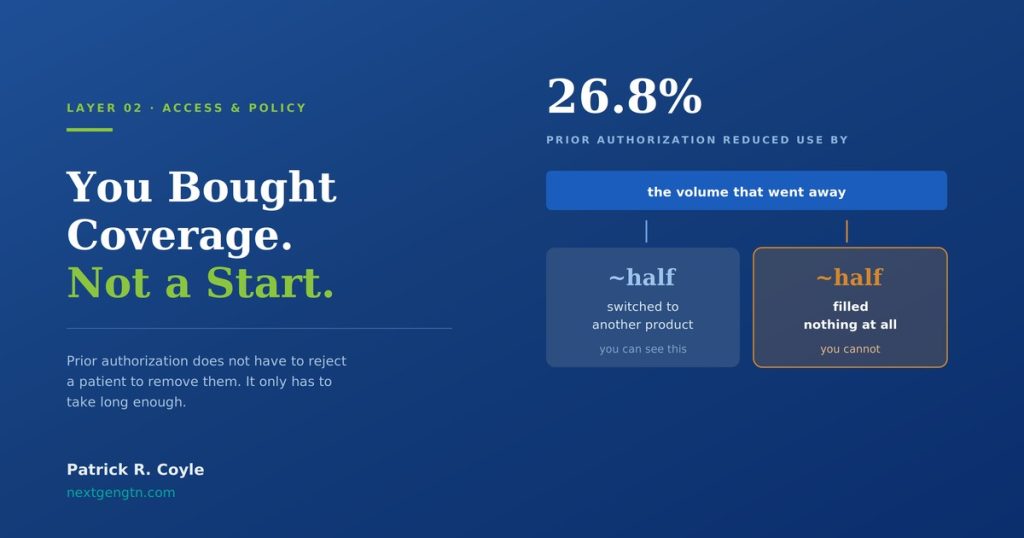
The short version: A rebate buys a position on a formulary. It does not buy a patient on therapy. Prior authorization removes roughly a quarter of targeted utilization, and about half of those patients do not switch, they abandon, which no market share report records. Before accepting the next contract, price the coverage against patient starts rather than approvals, actual authorization wait times, and administrative versus clinical denials.
Layer 02 · Access & Policy
The rebate buys a position on a list. It does not buy a patient on therapy.
By Patrick R. Coyle
Access negotiations end with a celebration. The product is covered. The tier is acceptable. The rebate was expensive but the alternative was worse.
Then the launch curve underperforms, and the conversation turns to uptake, to the sales force, to the market. Almost never to the thing that was agreed in the contract room.
Covered is a status. Started is an outcome.
A formulary position tells you a claim will adjudicate if it gets that far. It says nothing about whether it gets that far.
Between the two sits utilization management, and it is no longer an edge case. Analysis of 2024 Medicare Part D found that half of Part D drugs carried some form of utilization management, with 32 percent of plan enrollees subject to prior authorization and 42 percent to quantity limits. Over the same period, the standard exclusion lists maintained by the three largest PBMs, which together handle close to 80 percent of US prescriptions, grew past 600 products.
Utilization management is not something that happens to your product after the negotiation. It is frequently part of what you accepted during it.
What prior authorization actually does to volume
One Part D analysis put numbers on it. Prior authorization reduced use of the targeted drugs by 26.8 percent and lowered drug spending by roughly $96 per beneficiary-year, against about $10 per beneficiary-year in administrative cost to run it.
From the payer’s seat that is a return of nearly ten to one. It works.
The part worth sitting with is where the 26.8 percent went. Affected patients split roughly evenly between those who were redirected to a related drug and those who did not fill a prescription at all.
Where the reduction goes
About half switch to another product. You lost the patient to a competitor, and you can see it.
About half fill nothing. No competitor gained them. Nobody treated them. And nothing in your data shows a loss, because there was never a paid claim to lose.
The first half turns up in market share and gets discussed. The second half turns up nowhere.
The wait is the mechanism
It is tempting to read abandonment as a denial problem. Mostly it is not. It is a duration problem.
The American Medical Association’s 2025 physician survey, published in 2026, found that 95 percent of physicians said prior authorization delays access to necessary care, and 79 percent reported that patients abandon treatment because of authorization friction. Practices reported completing around 39 prior authorizations per physician per week, consuming about 13 hours of physician and staff time.
Nothing in that describes a decision to deny. It describes a queue. And a patient sitting in a queue with no status, no estimated date and no owner will eventually conclude the answer was no.
Prior authorization does not have to reject a patient to remove them. It only has to take long enough.
Why this lands in Layer 02 and not in patient services
Every organization I have worked with treats authorization friction as an operational problem. Hub staffing, turnaround times, e-PA adoption, better forms. All of that helps at the margin.
But the requirement itself was not created in operations. It was created in a contract, in exchange for a position, in a room where the tradeoff was priced as rebate against tier and rarely as rebate against abandonment.
Which means the honest accounting looks like this. You paid a rebate to be covered. Attached to that coverage was a mechanism that removes a share of the patients who would otherwise have started. You are funding both sides of the same transaction, and only one side appears in the gross-to-net bridge.
Three things worth pricing before the next contract
What does the utilization management attached to this position cost in starts?
Not in approvals. In starts. If nobody has estimated it, the tradeoff was priced on one side only.
How long does the wait actually run, and who is watching it?
Name a person. If the answer is the hub vendor, ask what happens on day nine, and whether anyone sees it who is measured on net revenue.
Can we tell a clinical denial from an administrative one?
Reject codes are recorded to resolve a transaction, not to explain a market. Categorizing by what a code says rather than by what it means is the most common analytical error in this work.
Market access is a financial topic, not a medical one. The contract sets the price. The mechanism attached to it sets the volume.
Sources. Utilization management prevalence, PBM exclusion list growth and the Part D prior authorization effect size are drawn from Trilliant Health’s 2026 study of pharmacy utilization management and prior authorization outcomes, which compiles published research and industry data. Physician survey figures are from the American Medical Association’s 2025 Prior Authorization Physician Survey, released in 2026. Figures are reported as published; no product, manufacturer, payer or commercial arrangement is described or implied, and no client data is used.
About the Author
Patrick R. Coyle built the NextGen GTN™ curriculum and the Patients + Profitability™ philosophy it rests on. He previously served as VP & CFO of Eisai Americas and led Gross-to-Net practice areas at two global advisory firms, with senior finance and commercial roles at Novartis, Insmed, and Bayer.
More frameworks, guides, and tools in the Resource Library. Reach him at hello@patrickrcoyle.com.