
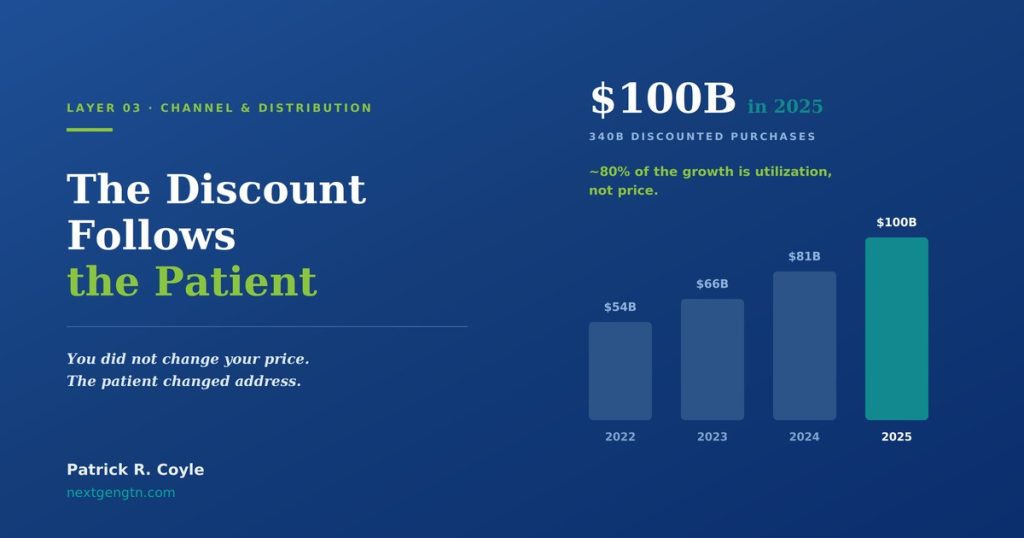
The short version: Net price can fall without a single price change because the patient changed address. Most 340B growth is utilization, not price, and every unit that moves through a covered entity instead of another site of care carries a lower net price that shows up months later. Ask three questions each quarter: what share of units moved through covered entities, what data prevents seeing each path, and who owns site-of-care mix separately from volume.
Layer 03 · Channel & Distribution
You did not change your price. The patient changed address.
By Patrick R. Coyle
Distribution gets treated as logistics. Warehouses, wholesalers, service fees, a chargeback process that somebody in operations owns.
It is not logistics. It is the single largest uncontrolled variable in your net price, and most brands cannot see it moving.
A number worth sitting with
HRSA reported that discounted purchases under the 340B program reached $100 billion in 2025, up roughly 23 percent on the $81.4 billion recorded for 2024. Disproportionate share hospitals accounted for around 80 percent of that.
Valued at list rather than at the discounted price, IQVIA put the same purchases at $179.5 billion. The gap between those two figures, roughly $79.5 billion, approximates what covered entities retained.
For scale: Drug Channels Institute estimated the entire US gross-to-net bubble for brand drugs at $416 billion in 2025. One program now accounts for close to a fifth of it.
340B, 2025
$100.0B purchased at 340B prices
$179.5B value of the same units at list
$79.5B the difference, retained by covered entities
The growth is not price. It is volume.
This is the part that changes what you do about it.
Published price-volume-mix analysis of 340B growth between 2018 and 2024 found that utilization accounted for roughly 80 percent of the growth measured at list price, and close to all of it measured at 340B prices.
Read that plainly. The program did not get bigger mainly because manufacturers raised prices. It got bigger because more units moved through it.
More units move through it when more care is delivered inside a covered entity, or dispensed through a contract pharmacy attached to one. Which is a statement about where patients are treated, not about what anyone charged.
Your net price can fall several points in a year without a single pricing decision being made anywhere in your company.
Why nobody catches it
Site-of-care drift is uniquely hard to see, for three reasons that compound.
It looks like success. Units are moving. Demand is intact. Prescriptions are being written and filled. Every volume metric on the commercial dashboard is healthy, because volume genuinely is healthy. Only the price per unit moved.
It arrives late and aggregated. Chargebacks reconcile after the fact. By the time the mix shift is visible in the net, the quarter it happened in has closed, and the explanation offered is usually gross-to-net rate rather than the channel decision underneath it.
The visibility was traded away. Data rights at each handoff are negotiated, usually for volume, service intensity or price. A brand that cannot see dispense-level behavior did not choose invisibility. It chose something else, several separate times, and invisibility was the currency it paid in.
This is a Layer 03 decision with a Layer 05 consequence
Network design, site-of-care strategy, specialty routing and contract pharmacy exposure are decided by Trade and Distribution, frequently on operational criteria. Service levels, fill rates, coverage of geography, cost to serve.
The consequence lands months later in Finance, as a deduction line with no attributable cause, defended in a meeting where nobody from Trade is present.
Both groups are doing their jobs. The decision and the consequence simply live in different rooms, on different timelines, measured by different people.
Three questions for the channel review
What share of our units moved through a covered entity last quarter, and what was it the quarter before?
If nobody can answer that inside two weeks, drift is not something you would detect. It is something you would eventually be told about.
At what data level can we see each path, and what question can that level not answer?
State it honestly, path by path, and write the unanswerable question next to it. That list is your exposure.
Who is accountable for mix, as distinct from volume?
Volume has an owner in every organization. Mix usually has none, which is precisely why it moves.
None of this is an argument about whether 340B is good policy. That argument is real, it is contested, and it has serious people on both sides. This is a narrower point: whatever you believe about the program, its growth is being driven by where care happens, and where care happens is a channel decision somebody in your company is making.
Distribution is no longer logistics. It is where your net price is set, by people who are not measured on net price.
Sources. 340B purchase totals and covered entity mix are from the Health Resources and Services Administration’s 2025 annual report on covered entity purchases, drawn from the Prime Vendor Program, which HRSA notes captures most but not all 340B transactions. List-price valuation and gross-to-net bubble figures are from IQVIA and Drug Channels Institute analyses published in 2026. The price-volume-mix decomposition of 340B growth is from published research covering 2018 to 2024. No product, manufacturer, covered entity or commercial arrangement is described or implied, and no client data is used.
About the Author
Patrick R. Coyle built the NextGen GTN™ curriculum and the Patients + Profitability™ philosophy it rests on. He previously served as VP & CFO of Eisai Americas and led Gross-to-Net practice areas at two global advisory firms, with senior finance and commercial roles at Novartis, Insmed, and Bayer.
More frameworks, guides, and tools in the Resource Library. Reach him at hello@patrickrcoyle.com.